
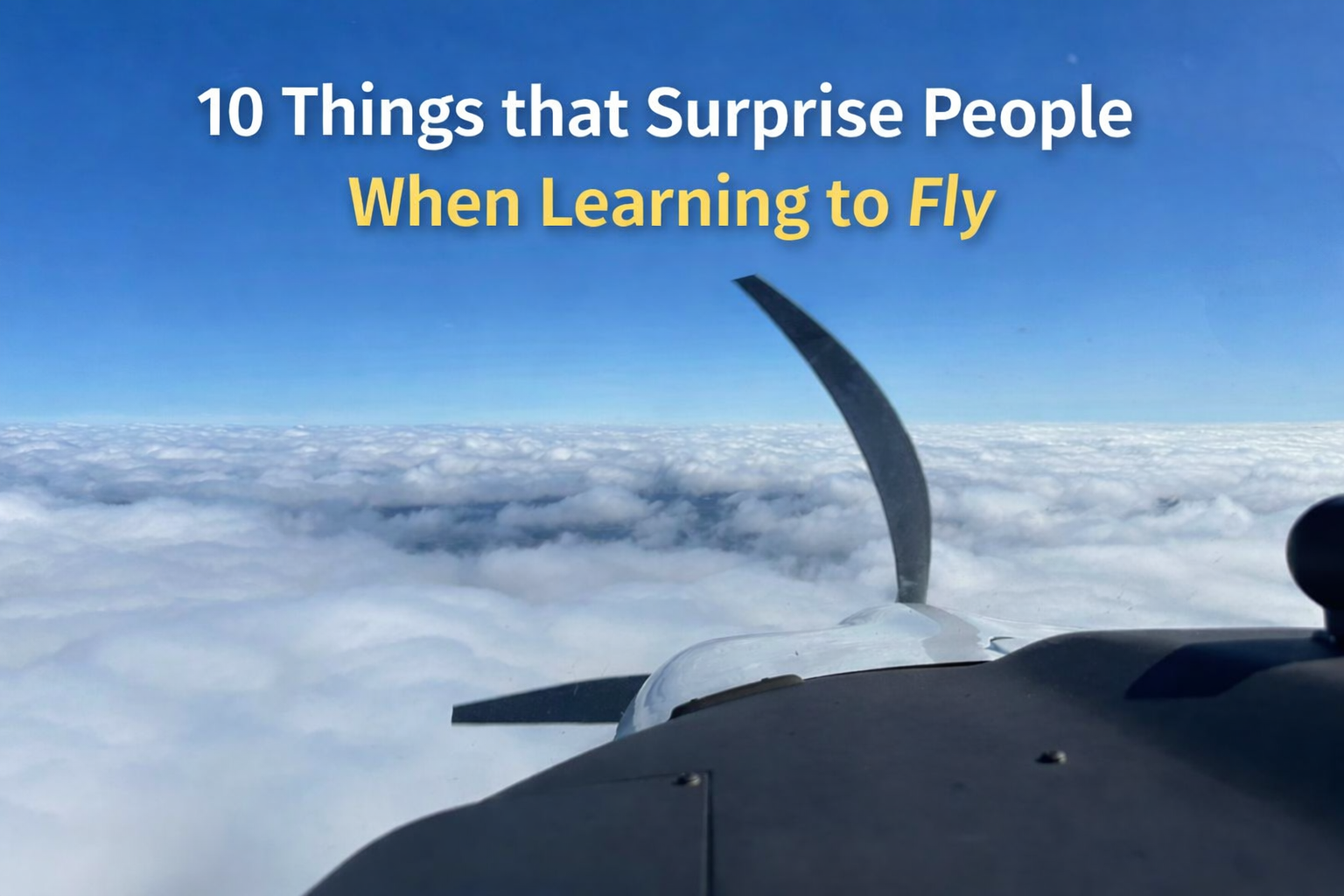
Most people walk into their first flight lesson with a Hollywood-shaped idea of what flying is like. You expect to feel like a fighter pilot, wind, speed, and instant mastery. What you don't expect is how profoundly the experience will rewire the way you see the world, and yourself.
At Vertical Vision Flight Academy, we've guided hundreds of students through their first steps into aviation. Without fail, there's a moment, usually around the third or fourth lesson, when the eyebrows go up, and someone says, "Wait… I didn't know it was like this." Here are the ten things that consistently catch new student pilots off guard.
Surprise #1
Flying Is More About Thinking Than Doing
New student pilots expect flying to be a physical challenge, requiring reflexes, muscle memory, and quick hands on the controls. What actually happens is quite different. You spend the majority of your time planning, anticipating, and problem-solving. The cockpit rewards pilots who stay three steps ahead, not those who react fastest.
Aircraft respond slowly and predictably. Every instructor at Vertical Vision will teach you to "aviate, navigate, communicate," and over time, you'll come to understand that the most critical skill in the cockpit is mental bandwidth management, not joystick dexterity. Strong aeronautical decision-making is the foundation of safe flight training.
Surprise #2
Small Planes Feel Nothing Like Commercial Airlines
If your only experience in the air has been in economy class, your mental model of flight is almost entirely wrong for a small aircraft. General aviation planes, a Piper Archer, for example, are intimate, tactile, and alive in a way a commercial jet simply isn't. You feel every updraft and gust. The controls respond directly under your hand. You can take in the entire horizon without a cabin window cutting it off.
Some student pilots feel overwhelmed during their first lesson. Others experience an immediate sense of freedom they weren't prepared for. Either way, nothing about boarding a 737 prepares you for what it feels like to actually fly an airplane.
Surprise #3
There Is a Significant Amount of Aviation Regulation to Learn
Before you can legally carry passengers, you need to understand airspace classifications, right-of-way rules, visibility minimums, altitude requirements, and a substantial set of FAA regulations. The FAA Private Pilot written exam exists for a reason, and it is not a formality.
Students who love learning embrace this challenge. Those who expected to skip straight to "the cool flying part" are often surprised by the depth of knowledge required. But here is the upside: once you truly understand the rules of the sky, you carry a quiet confidence that changes the way you look up at every passing aircraft for the rest of your life.
Surprise #4
Your First Solo Flight Is an Unforgettable Emotional Experience
Almost every pilot recalls their first solo flight with the same significance they'd give a major life milestone, a graduation, or a wedding. The moment your instructor steps out of the plane and you taxi alone to the runway for the very first time, something changes permanently.
Student pilots describe it as simultaneously terrifying and electrifying. The airplane suddenly feels lighter because it literally is, with one less person on board. Radio calls feel more real. The sky feels bigger. And when you touch down by yourself for the first time, the sense of accomplishment is the kind that doesn't need an audience.
Surprise #5
Weather Controls Everything, and You'll Become Obsessed With It
Before you start flight training, the weather is background noise. After your first few lessons, you'll be reading METARs and TAFs over breakfast. You'll check wind-aloft forecasts before road trips, you're not even flying. You'll know what a convective SIGMET is and why it matters.
Most student pilots are surprised by how heavily weather influences both the training schedule and every safety decision. Canceled lessons frustrate beginners. Experienced pilots understand: the decision not to fly is often the best decision you'll make. Good aeronautical decision-making always starts with respecting the weather, not fighting it.
Surprise #6
Landings Take Far Longer to Master Than Everything Else
Many students assume that landing should be the straightforward part after all the complexity of navigation and airspace management. In practice, the landing is where most of the real learning happens, and consistent, smooth touchdowns take dozens of practice approaches to develop.
The flare, the roundout, the power reduction, the sight picture, all of it must blend into one fluid motion as the runway rises to meet you. It's also common for a student to have a lesson where it all clicks perfectly, then seem to lose the skill entirely on the next flight. This is completely normal, genuinely frustrating, and an expected part of the learning process.
Surprise #7
The Aviation Community Is Surprisingly Welcoming
Many prospective student pilots expect the aviation world to feel exclusive or intimidating, populated by seasoned veterans who have forgotten more about flying than you'll ever learn. The reality is almost always the opposite. Pilots genuinely want to talk about flying. They are eager to share tips, swap hangar stories, and pass along hard-earned lessons.
Stop by any general aviation airport on a Saturday morning, and you'll find people gathered around aircraft, talking over coffee. Flying creates a shared language and a shared identity that crosses cultures and careers. From the moment you receive your student pilot certificate, you belong to a community that is genuinely global and surprisingly close-knit.
Surprise #8
Flight Training Costs More and Takes Longer Than You Might Expect
We believe in being upfront and transparent about this. The FAA minimum flight time for a Private Pilot Certificate is 40 hours, but the national average is closer to 65–75 hours. Weather delays, scheduling gaps, and the reality that some maneuvers simply require more repetition all contribute to a longer timeline and higher total cost than the minimum suggests.
Students who navigate this well are the ones who approach flight training as an investment rather than a one-time purchase. A pilot certificate does not expire, it does not go out of style, and the discipline and precision you develop throughout the process will serve you in every area of your life long after you earn your wings.
Surprise #9
Your Relationship With Maps, Navigation, and Geography Changes Forever
VFR (Visual Flight Rules) navigation requires you to read the landscape below and match what you see to a sectional aeronautical chart. Suddenly, a road atlas is no longer abstract. Water towers carry meaning. Railroad tracks become navigational landmarks. You develop a three-dimensional spatial awareness of your region that no GPS app can replicate.
Students consistently report that even after a single cross-country flight, they look out of car windows differently, tracing terrain features, identifying landmarks, mentally noting where a forced landing might be possible. The cockpit genuinely changes the way you see the ground beneath you.
Surprise #10
Learning to Fly Will Change Who You Are
This is the surprise nobody warns you about, because it is nearly impossible to explain until you have experienced it. Flight training demands a level of personal accountability that modern life rarely requires. When you are pilot-in-command, there is no one else to defer to. No safety net, no undo button, no IT department. You are responsible for the aircraft, for every person on board, and for every decision you make from engine start to shutdown.
Carrying that responsibility consistently, over months of training, builds something real. A steadiness under pressure. A habit of thinking carefully before acting. An honest awareness of your own limits and how to work within them. Students regularly tell us that the skills developed in the cockpit, disciplined checklists, situational awareness, decisive action, and candid self-assessment have transformed their professional and personal lives in ways they never anticipated.
Earning a private pilot certificate is not simply about adding a credential to your wallet. It is about becoming the kind of person who is capable of earning it.