
If you're considering learning to fly, you might be wondering: "Can this actually be hard?" The answer is honest: it can be challenging at times. But challenging doesn't mean impossible or out of reach. With the right support, structured training, and realistic expectations, most determined people successfully earn their pilot's license. Many of our students at Vertical Vision Flight Academy—working professionals, busy parents, career-changers—have done it. You can too. Let's break down where challenges can arise, how to navigate them, and why the journey is incredibly rewarding.
The Short Answer: It Can Be Challenging—But It's Absolutely Achievable
Learning to fly can require dedication, study, patience, and a willingness to embrace challenges. It's not a skill you pick up passively. However, "challenging" doesn't mean "impossible." For many people, it's quite manageable. With the right approach, structured training, and support, you can absolutely earn your pilot's license. Thousands of people do it every year—including many of our students at Vertical Vision Flight Academy. You can too.
Some students find the learning curve smooth and exciting. Others encounter specific obstacles: unpredictable weather, complex aeronautical concepts, or the need for consistent outside study. But each of these challenges has a solution. That's what this post is about—understanding where difficulty might arise and having a clear path forward.
Where Challenges Can Arise (And How to Handle Them)
Potential Challenge #1: Weather Delays Can Be Unpredictable and Frustrating
Something many new pilot students discover: You can't always fly when you plan to. Weather is the ultimate schedule variable.
You've booked your training flight for Thursday at 3 p.m. You've arranged your work schedule, you're mentally prepared, and you're ready to practice your approaches. Then you wake up to low clouds, poor visibility, or gusty crosswinds that exceed safe limits. Your flight gets postponed.
This can happen during your training. Des Moines experiences fog, thunderstorms, wind, and seasonal weather that sometimes grounds aircraft for extended periods. In winter, ice and snow are factors. In summer, afternoon thunderstorms occur frequently.
Why This Makes Learning Harder:
- Training momentum breaks: You lose the rhythm of regular practice. Skills atrophy if weeks pass between flights.
- Scheduling stress: Rescheduling flights disrupts your life, work calendar, and motivation.
- Cost implications: Extended training timelines mean higher overall costs as you pay for instructor time and aircraft rental over longer periods.
- Mental toll: Repeated cancellations can feel demoralizing, especially when you're building toward a goal.
How to Manage Weather Delays:
- Expect them: Weather delays are not failures—they're part of aviation. Accept this reality upfront and plan accordingly.
- Build flexibility into your timeline: Don't schedule critical training around fixed deadlines. Allow extra weeks as a buffer.
- Use cancelled days productively: When weather grounds your aircraft, use that time for ground school, study, or simulator practice. (More on this below.)
- Understand the safety reason: Weather delays exist to keep you alive. Respecting weather limits is part of becoming a safe pilot.
- Stay scheduled in season: Training year-round is smarter than cramming all your flying into one month. Consistent practice, even if spread out, builds better skills.
Potential Challenge #2: Aeronautical Concepts Can Take Time to Absorb
Many students expect: Take a lesson with an instructor, fly the airplane, go home. Done.
Reality: Lessons are the foundation. Real understanding often develops through a mix of flight experience and outside study.
Flying involves more conceptual learning than you might initially expect. You're not just practicing physical skill—you're mastering systems, aerodynamics, regulations, and procedures. Some of these concepts are genuinely intricate and can take time to fully grasp from multiple angles.
Why Some Concepts Take More Time:
- Aerodynamics: Lift, drag, stall speed, angle of attack—these are invisible forces. Understanding them requires visualization and study.
- Aircraft systems: Electrical, fuel, hydraulic, and propeller systems interact in complex ways. You need to understand these interactions.
- Regulations: Airspace rules and flight operations requirements are detailed. Precision matters for safety.
- Weather: Understanding weather charts, wind patterns, and atmospheric phenomena requires dedicated learning.
- Navigation: Reading sectional charts, calculating wind correction—these skills develop with practice and study.
Here's the reassuring part: No pilot understands everything immediately. Your instructor doesn't expect you to. The expectation is that you'll study consistently, ask questions, and build understanding over time—just like any complex skill.
What Self-Study Typically Looks Like:
- 30–45 minutes most days: Reading your textbook, watching instructional videos, or reviewing notes.
- Before each flight: Reviewing the specific maneuvers or concepts you'll practice that day.
- After each flight: Reviewing what you did, what went well, and what needs improvement.
- Ground school prep: If attending group ground school, reviewing materials beforehand so class time is more effective.
- Practice tests and quizzes: Self-testing to check your understanding before your checkride.
Many students find that consistent, modest study—30 to 45 minutes daily—works well. Students who combine regular flight time with dedicated self-study tend to progress faster and develop deeper understanding. It's the combination that works, not the flying alone.
Potential Challenge #3: Information Volume Can Feel Overwhelming (But It's Manageable)
The challenge: There's a lot of information to learn. Early on, it's easy to feel like there's too much. The good news: This feeling is temporary and solvable.
Your first ground school textbook might be lengthy. Topics interconnect. You might study for a while and wonder if you're making progress. This is a common experience, and it's one reason some people feel pilot training might be overwhelming. But here's the key: This feeling usually resolves when information is organized well and explained in digestible pieces.
How Vertical Vision's In-Person Ground School Solves These Challenges
At Vertical Vision Flight Academy, we've designed our training specifically to address these hardships. One of our biggest advantages is our structured, in-person ground school program. Here's how it helps:
1. Organized Information: Breaking It Into Clear, Logical Pieces
Instead of giving you a large textbook and asking you to figure it out alone, our instructors organize aviation knowledge into a structured progression of lessons that build on each other. Each lesson creates a foundation for the next one, allowing your brain to connect new information to what you've already learned. This interconnected approach means challenging concepts aren't presented in isolation—they're woven into a framework that makes sense.
By breaking down complex topics and showing how they relate to what you've already mastered, you build stronger understanding and better retain the material. Nothing feels random because everything connects to what came before and prepares you for what comes next. This structure dramatically reduces overwhelm.
2. Expert Instructors Explain Concepts Visually and Contextually
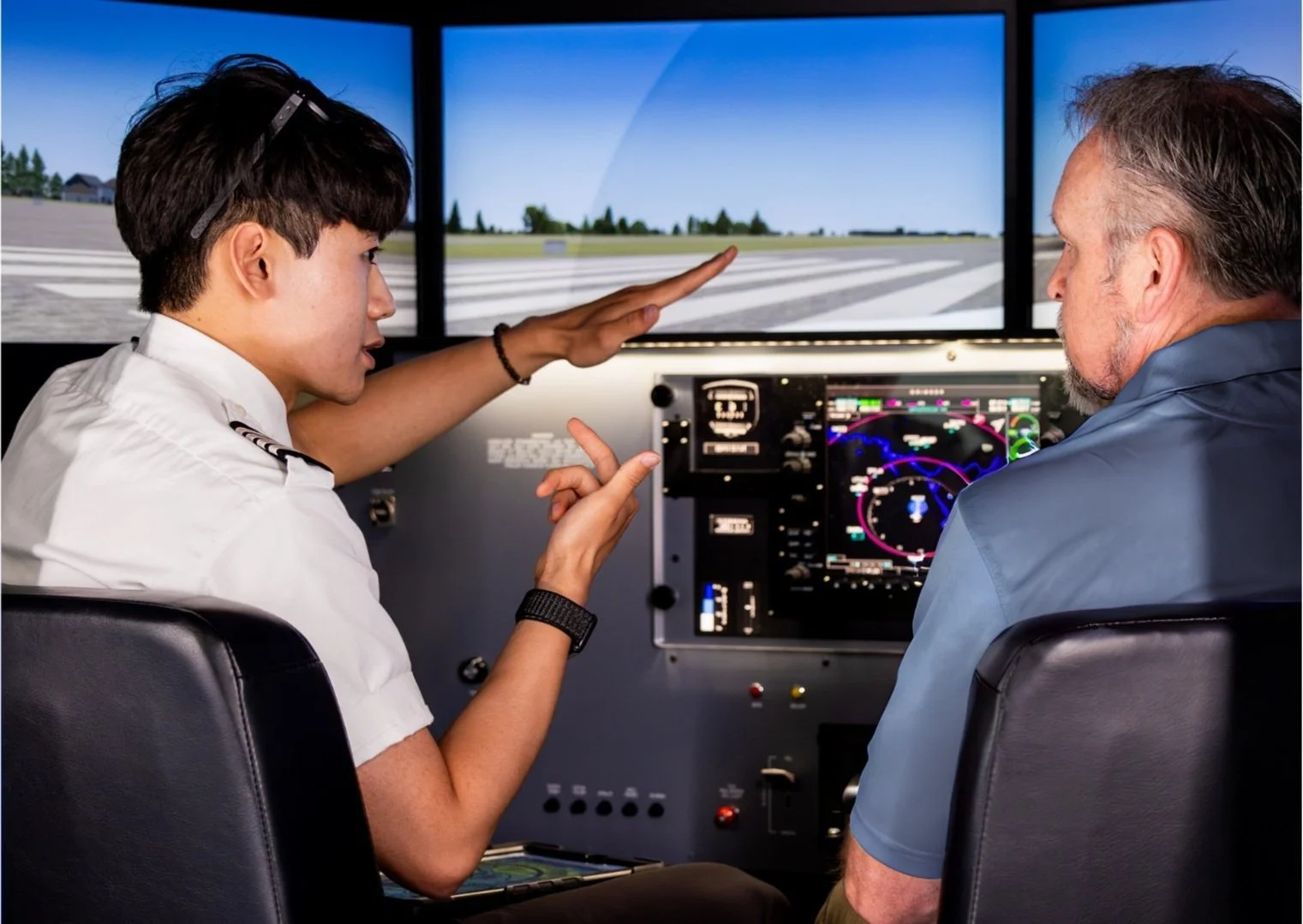
Reading about lift in a textbook is different from having an instructor draw it on a whiteboard, explain it with analogies, and connect it to what happens when you actually fly. Our ground school instructors:
- Use visuals: Diagrams, animations, and demonstrations that make invisible concepts visible.
- Provide context: "Here's why this matters in real flying. Here's how this could kill you if you misunderstand it."
- Answer questions immediately: If something doesn't make sense, you ask in class. Your instructor clarifies on the spot, not days later.
- Identify problem areas: Experienced instructors know which concepts typically confuse students. They spend extra time there.
3. Group Learning Creates Community and Reduces Isolation
When you study alone, every confusion feels personal. "Why don't I understand this? Everyone else probably gets it." In our group ground school classes, you quickly realize: everyone is confused about something. That classmate struggling with weather theory? You might be naturally great at it. The reverse is true for systems. Or navigation.
Hearing other students ask questions—especially questions you were too embarrassed to ask—is incredibly validating. You realize you're not alone in this struggle. Discussion and peer learning reinforce concepts for everyone.
4. Structured Progression That Keeps Everything Connected
Our instructors know where you are in your flight training. They align ground school content with what you're practicing in the air. You learn about stalls in ground school right before (or right after) practicing stalls in the airplane. The concepts reinforce each other.
This connection prevents the feeling of learning random, disconnected facts. Everything relates. Everything has purpose. That makes learning feel less like memorization and more like building real understanding.
5. Accountability and Motivation Through Community
When you're studying alone, it's easy to skip a day. Or two. Or get discouraged and quit. In a group ground school setting, you're part of a cohort. You see classmates progressing. You don't want to fall behind. There's gentle accountability that keeps you moving forward.
Plus, making friends with other students who share your goal is genuinely motivating. You're all in this together. That sense of community carries you through the hard days.
The Bottom Line on Ground School
Learning to fly can involve absorbing a lot of information. But when instruction is organized, taught by experts who explain the "why," and supported by community—that transforms the experience. It goes from "overwhelming fire hose" to "logical progression I can master."
So What Makes It Worth the Effort? The Reward Side of the Equation
We've talked about the challenges. Now let's talk about why people take them on. The answer is: because the accomplishment and the reward are genuinely extraordinary.
The Moment You Earn Your License
There's a moment during your checkride when you perform a maneuver perfectly. Your examiner makes a note. You look at them. They nod slightly. And you know: you've got this.
That feeling, and then the official moment when they hand you your temporary certificate and say "Congratulations, you're a pilot"—nothing compares to it.
You've spent months studying. You've overcome weather delays. You've pushed through confusion and self-doubt. You've spent money. You've sacrificed time. And then, on that checkride day, it all comes together. Every struggle was worth it for that single moment.
You've Accomplished Something Genuinely Difficult
There's a reason earning a pilot's license is prestigious. Not everyone does it. Most people who consider it talk themselves out of it because it's hard. The difficulty is the point. When you become a pilot, you join a small group of people who pushed through a legitimate challenge and succeeded.
That sense of accomplishment stays with you. Years later, you're still proud. You introduce yourself: "I'm a pilot." And it means something. It's a tangible achievement in a world where so many goals are abstract or never completed.
The Pride in Your Capability
You're Now Capable of Flying an Aircraft
This isn't hyperbole. You've spent months learning to control a machine that can take you anywhere. You understand how it works, how to keep it safe, and how to navigate to your destination. That's a genuinely rare skill. When you're sitting in the pilot's seat—your hand on the yoke, your eyes on the horizon—you feel the weight of that responsibility and capability.
You've Beaten Self-Doubt
Learning to fly forces you to confront doubt. "Can I really do this?" You probably asked yourself that multiple times during training. And then you did it anyway. That experience—pushing through doubt and proving to yourself that you're capable—changes how you approach other challenges in life. You know you can do hard things.
You Now Have Unlimited Possibilities
Once you're licensed, the sky is literally open. You can fly to a beach for breakfast. You can visit friends across the state. You can explore places cars can't reach. You can turn flying into a hobby, a side income, or a full career. That freedom is intoxicating.
You've Joined a Community of Pilots
Pilots are a unique bunch. There's an instant camaraderie. You can walk into any airport in the world and find people who understand the specific joy and challenge of flying. You're part of something bigger than yourself. That sense of belonging is powerful.
The Real Picture: The Right Support Makes a Significant Difference
Here's what we've learned at Vertical Vision: Students who struggle usually aren't lacking ability. They're lacking good guidance on how to break down the material into manageable pieces and stay organized. The students who thrive are those who get structured support, clear expectations, and instructor guidance—not necessarily the naturally talented ones.
The students who succeed aren't necessarily the smartest. They're the ones who:
- Enroll in structured ground school instead of trying to self-study
- Accept weather delays as normal, not as failures
- Show up consistently and study regularly
- Ask questions when they don't understand
- Connect with their instructor and training peers
- Keep their eyes on the goal: earning that license
You probably have these qualities already. That's probably why you're reading this.
Ready to See If Pilot Training Is Right for You?
Schedule a no-pressure consultation with one of our instructors. We'll talk about your goals, what to expect, and how our structured training program can support your success.
Schedule Your ConsultationFrequently Asked Questions: Challenging Parts of Pilot Training
Q: How much does weather delay training?
It varies by season and location, but most students experience 2–4 weeks of cumulative delays during their training. In winter, it can be more. The best approach is to build extra weeks into your timeline and use cancelled flying days for ground school study.
Q: How many hours per week should I study outside of lessons?
Most students need 5–10 hours per week of self-study. This includes reading, watching videos, taking practice tests, and reviewing notes. The exact amount depends on how quickly concepts click for you and how much flight time you're getting.
Q: What's the most challenging part of learning to fly?
For most students, it's managing the mental load. There's so much information, and early on, it's hard to see how it all connects. Structured ground school helps because instructors teach you how to organize and prioritize information instead of drowning in it.
Q: Can I learn to fly if I'm not naturally good at math/science?
Absolutely. You don't need to be a physicist to understand how airplanes fly. You need conceptual understanding, not advanced math. Our instructors explain things in ways that work for different learning styles.
Q: Is it normal to feel overwhelmed during training?
Yes. Almost every pilot student feels overwhelmed at some point. If you're feeling lost, that's a sign to step back, organize your study materials, or talk to your instructor. Overwhelm is a sign you need to adjust your approach—not a sign you should quit.
Q: How do I stay motivated when training takes longer than expected?
Connect with your goal—why you want to fly. Connect with your training community—other students who get it. Celebrate small wins: first solo flight, first night flight, first cross-country. And remember: every accomplished pilot faced weather delays too. You're not behind; you're normal.
Q: What if I fail my checkride?
While checkride failures do happen, they're rare. At Vertical Vision, over 90% of our students pass their checkride on the first attempt. That speaks to our structured training and thorough preparation. But if it does happen: you can retake it. Your instructor will identify exactly what you need to improve. You'll study that specific area and be better prepared the next time. It's disappointing, but it's recoverable—and unlikely with our training approach.
Q: How long does pilot training actually take?
The FAA minimum is 40 flight hours, but most people complete their Private Pilot rating between 60–80 hours plus extensive ground school. In real time, this usually takes 3–4 months for the average student depending on how often you fly, how quickly you progress, and whether you encounter weather delays. Part 61 training (which we offer) is flexible—you train at your pace.
You Can Do This—And We're Here to Help
Is learning to fly sometimes challenging? Yes. Weather delays can happen. Complex concepts require study. There's information to learn and retain.
But here's what's also true: Most people who approach it the right way succeed. Our structured ground school helps you understand the material without feeling overwhelmed. Our flexible Part 61 training works around your schedule and pace. And our community of instructors and students supports each other.
At Vertical Vision Flight Academy in Des Moines, we've helped hundreds of people accomplish this goal. Many of them didn't think they could. But they did.
So ask yourself: Can learning to fly be challenging? Yes. But can you do it? Absolutely.